Monday, August 18, 2008

Wolvercote Walk

Wolvercote is a small village three mile from the center of Oxford.  It was incorporated into the city of Oxford in about 1930.  You enter the village from Woodstock Road at First Turn, taking a bridge across the railway tracks.
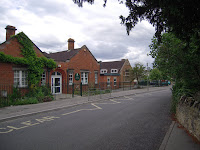

Continuing
 down the road
 is the local primary
 school established in 1814.


Across the street is the church, with a cemetery in the church yard.  The interior shows evidence of the rebuilding of the church in the 19th century.  The baptismal font was a part of the original church, from the 14th century.


Continuing down the road, you come to the convenience store in upper Wolvercote which includes a post office. The store is closed because I took this picture on Sunday.  Convenience means
 that it is opened after 5:30 a couple days a week.

Further down the hill is the one of three pubs in the village, the Plough.


The next feature of note is the canal, used until the mid 1800s when the railroads came through.  Today it is used as a tourist attraction with a number house boats, some of which are for rent.  


A real house boat, with a garden on the roof.

 A boat going through a small lock.


Coming up from the canal, we go through the business district of Lower Wolvercote.  This is the convenience store that I frequent.  The proprietor is a congenial person who already knows what my favorite candy bar is.


Continuing down Godstow Road, we pass a number of homes 

 the Baptist Church


go over the Mill Stream and pass the sheep pasture.


At the outskirts of Wolvercote, we arrive at the 
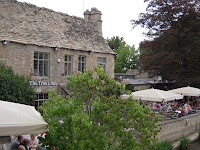
Trout Inn.  This is a popular setting for 
the Inspector Morse series.


Further down the road are the ruins of the Wovercote Nunnery, founded in 1139.  During the British Civil War, Crowmwell used the buildings as his headquarters. This area was the chapel.

 
On the way home we pass a community orchard.  The heritage apples are sold during a fall festival to finance the orchard.


Next to the orchard are the community garden plots
 or allotments as they are known here.


We return to the business area of Lower Wolvercote,  with  two pubs
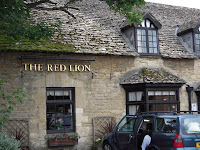
                                                    and the village playground.


Down the block is the Chinese fish and chips shop.  My house is up the block from here.


Tuesday, August 12, 2008

Eccentric Walk of Oxford

This weekend I went on an Eccentric Walk of Oxford.  This is St. John's college, the only college not established by a person of noble birth or a cleric.  The founder was a tailor. He named the college after St John, the patron saint of tailors.  Interestingly, St. John's is said to be the riches college of the 39 colleges in Oxford.  

This is the court yard of St. John's. It was patterned after an Italian    foundling home.  Tony Blair was a student here and smoked his last cigaret outside the chapel. His wife would only marry him if he quit and he had one last smoke just before the wedding.


This is building that originally housed the Ashmolean Museum. At that time the collection included natural history material such as the last stuffed Dodo bird.  It was burned as trash by a hapless employee.  The basement of the building was the chemistry lab for Oxford colleges from 1635 to 1860.  It has a domed ceiling to contain any explosion that might have taken place. Currently the Museum of the History of Science uses the building. That collection includes a blackboard on which Einstein wrote one of his equations.


This is the Radcliffe Camera (Latin for chamber) where all Oxford students have their orientation and from where they graduate. The building to the left housed the university woman's jail in the 1800s.  The women were, of course, prostitutes who were in the area because the colleges were all male and the faculty was required to be celibate, or at least not married.  The police training manual indicated that one could tell a prostitute because she would be walking alone, after nine in the evening and without a hat.  To which I commented, "So that's why the Queen always wears a hat."  A German who was on the tour commented that it was evident that I was an American, because a Brit would not be so disrespectful as to associate the Queen with prostitution. 


These are the spires of All Souls College, a research college. There are no undergraduates here.  Scholars have research grants for up to five years. T.E. Lawrence wrote Seven Pillars of Wisdom while a fellow at this college.  The college is also known for its Mallard Dinner.


There are many other eccentric bits of information about Oxford, but the tour was only five pounds and I am satisfied that I got my money's worth.


Monday, August 4, 2008

Blenheim Palace

A couple of Saturdays ago, I visited Blenheim Palace, the birthplace of Winston Churchill.  Churchill's birth at the palace was a fluke.  His father was the younger son, not the Earl.  The Churchill's were visiting and Winston was born early.

Visitors are not allowed to take photos of the interior of the palace.  You can see some images a their website.

My impression of the place was that it is a museum.  To think that someone actually lives there, as the 11th Earl of Marlborough does, is bewildering.  I have worked hard to downsize my living situation, and here is someone who has responsibility for priceless works of art in his home.


In Notes from a Small Island, Bill Bryson wrote that he thought the Earl of Marlborough was tacky to open his home to tourists and even more tacky to have a small train running from the palace to the pleasure gardens.  I found the train a welcomed convenience.  The day was warm and the distance far enough that I really appreciated being able to ride a miniature train which was not nearly as tacky as it could have been.  The driver wore a white shirt and tie, not overalls and bandana as would have been the case in the States.  What I did find tacky was that the only way out of the palace was through the gift shop.

 
When I read Bryson's comments on the palace, I thought that the pleasure garden was well appointed rural setting made available to palace elite for romantic trysts.  I really was surprised when I realized that it was an area of oversized games and a large maze.  
I really wanted to do the maze.  It included two towers from 
which the maze goer could see the solution. I looked forward to solve the puzzle.  So I entered the maze ready to conquer this puzzle as I did the many sudoku I've solve. 


However, after spending a few minutes between tall hedges, my claustrophobia got the best of me and I had to make my way back to the beginning.


Then I went on to enjoy the lavender garden, 


the Butterfly House


and walked out through the gates of the palace and headed for home.


Wednesday, July 30, 2008

Office goings on


I forgot to include two members of the Advancement when I introduced the office before.

Deborah Lake is the head of Advancement for IFES and an avid motorcycle rider, shown here in her cycle regalia.  She recent rode her bike to an IFES meeting in Paris and survived to tell the tale.


Victoria   is Deborah's personal assistant.  She just came by to ask if I wanted a drink of water from the kitchen, a question she usually asks when she goes by.  She is fast becoming a good friend.


When the weather is nice, we often for to a local churchyard for a picnic. This photo includes people from several other IFES deparments, including IT, HR, and evangelism.

Monday, July 21, 2008

Port Meadow


Port Meadow is a large open area in north Oxford. According to Wikipedia, no plow has ever been used on this portion of land.  People from Oxford still graze cattle and horses on it. 


The meadow is bordered on the north by the 
village of Wolvercote


 On the west by the Wolvercote Millstream


On the east by a British Railway track


And on the south by the spires of Oxford
Andy Griffith has a monolog about the game of American football in which he concludes that the object of the game is to carry a pumpkin from one end of a cow pasture to the other without getting knocked down or stepping in something.  A walk in Port Meadow has similar cautions with the added hazard of bogs.  
One day I turned off the beaten path to look more closely at a stone monument. All of a sudden I was up to my knees in a muddy bog.  The first thought through my mind was how to get out and what would happen if I couldn't.  The meadow is well used, but not highly populated, and I was off the beaten path, which tends to avoid bogs. My second thought was sadness that there was no one around to take a picture, to memorialize my experience in the bog.  
I was soon able to pull my right leg out, nearly losing my shoe in the process.  When I extricated my left leg, I crawled on my hands and knees for several yards to solid land.  By then I was muddied up to my waist and I still had to walk about a half mile home through the streets of Wolvercote.  When I arrived, my landlady was helpful, but had a good laugh at the bedraggled foreigner who happened upon her doorstep.
I have learned to avoid the bogs and have not yet seen what is inscribed on the stone marker at that end of the meadow.

Monday, June 30, 2008

A week end in Oxford: Bus tour


This week end I took the bus tour around Oxford.  The post cards have better pictures than I might take, so I only took a few to convince you that I had actually had 
the experience.  
            I have become enough of an Oxford person that I was distressed at the large number of tourists in the city on         Saturday.  

   
This Saturday I went to the Museum of the History of Science which is located next to the circular building.  the museum was fascinating. I enjoyed seeing the actual equipment used in important experiments. They have a chalk board with one of Einstein's calculations in his own hand.  The building was actually the chemistry lab for Oxford from 1635 to 1850.  The basement, where the experiments took place, is vaulted so as to contain any explosions.


Monday, June 23, 2008

Oxford the beginning


First Days
I arrived in Oxford on June 28 with no glitches along the way.  My plane touched down at 1:40 pm and I made it through customs and the airport in time to catch the 2:20 bus to Oxford.  When I arrived at the park and ride stop that we had agreed on as my meeting place, I found out that there was no pay phone, so I had no way of letting Penny and Sarah knw I was in town.  I approached a kindly looking couple, explained the situation and asked them if they would be wiling to make a local call for me.  They agreed and left a very nice message on Penny's home phone and caught her on her mobile. (Pronounced with a long 'i') Penny and Sarah had not expected me to make the early bus and were still at the office.  They arrived shortly and whisked me away to a lovely dinner a Penny's and then to the apartment they had arranged for me to stay in until my room was available on Saturday. 

Friday I walked to the office for afternoon tea.  IFES really does live up to its commitment to be a student led indigenous organization.  the international office consists of 17 people, 18 now that I have arrived and we are looking forward to 19 when Daniel's visa is finally approved.  The communications department is consists of four five permanent people who do everything from write grants to communicate with field staff around the world to maintain the website.  My first assignment was to write the blurbs for Canada and the US for the updated web.

House hunting
Before I left Madison, I had searched the web and set up to rent a room in a house in a section of Oxford called Cowley.  The big draw was that the house was also the home of two dogs.  SAturday Penny came to take me to my new home.  As we wound our way through the streets of Oxford, it became evident that the house was not in Cowley, but another section that was not at all convenient for bus travel.  So I was back to square one, needing to find a place to stay and needing to vacate my current room in five days.

I started looking on Monday and found two places to look at Tuesday afternoon- one within walking distance of the office a single room in a building with two other occupants, co-ed, no dog, and a room across the street form Sarah with a very nice family, also no dog  and about 2.5 mile from the office.  Tuesday I also found another possibility in a section of Oxford called Wolvercote.  I single woman was renting a room in her home and she had a dog.  I went to look at it on Thursday and agreed to take it on Friday. 

The Office
I arrived for work on Monday June 2.  The first week I met everyone and got the feel for the place. (The group photo of the office shows the following members of the communications team from left to right: Anja (pronounced Anza), a native of Tunisia and the resident multilingual translator.  She keeps in touch with IFES staff around the world, gathering reports and encouraging the workers.  Sarah, a native of Canada and the primary writer.  She just completed the IFES annual report.  Andy, a local who is engaged to be married in October.  He keeps track of major donor communications and web statistics. The individual photo is Penny.  She has taught a Berkeley and lived in Canada.  She is the grant writer.  Pablo is also on the communications team.  He is in charge of the web and lives in Argentina.